
As climate talks return to the global stage, the language is familiar. Emissions targets. Climate finance. Clean energy transitions. Yet far from conference halls, climate change is already reshaping everyday life in quieter ways. Across many regions, people are moving not because they want to leave, but because staying has become harder.
Kenya offers a clear lens into this reality
Climate migration rarely arrives as a single dramatic event. Sometimes it follows sudden shocks, such as floods that displace households overnight. In 2024, flooding displaced hundreds of thousands of people across Kenya, according to the Internal Displacement Monitoring Centre(IDMC). At the same time, slower pressures are at work. Prolonged drought and rising temperatures have weakened pastoral and agricultural livelihoods, particularly in arid and semi-arid regions. The International Organization for Migration (IOM) reports that most climate-related displacement in Kenya remains internal, with families relocating within the country rather than crossing borders
What connects these movements is not weather alone, but systems under strain.
Electricity is one of those systems. Reliable power supports water access, health services, communications, and local businesses. When power systems are weak or unreliable, adaptation options shrink. Recovery after climate shocks slows. Vulnerability deepens. Over time, movement becomes less a choice and more a coping strategy.
Seen through a systems lens, climate stress and infrastructure failure reinforce each other. As climate impacts reduce income, households exhaust their options. Assets are sold. Consumption falls. Temporary migration becomes more frequent. If conditions do not improve, temporary movement can turn into longer-term displacement. This pattern is familiar across stressed systems, from fisheries to water networks, where short-term survival responses can unintentionally accelerate long-term instability.
Kenya’s energy transition shows both promise and limits. The country has expanded renewable generation, especially geothermal, wind, and solar, and launched its Energy Transition and Investment Plan in 2024 to guide long-term decarbonization and development. But sustainability is not only about clean energy capacity. It is about durability. Power systems must remain reliable under climate stress. Institutions must coordinate. Maintenance and data systems must keep pace with expansion. When these elements lag, clean energy growth can coexist with persistent vulnerability.
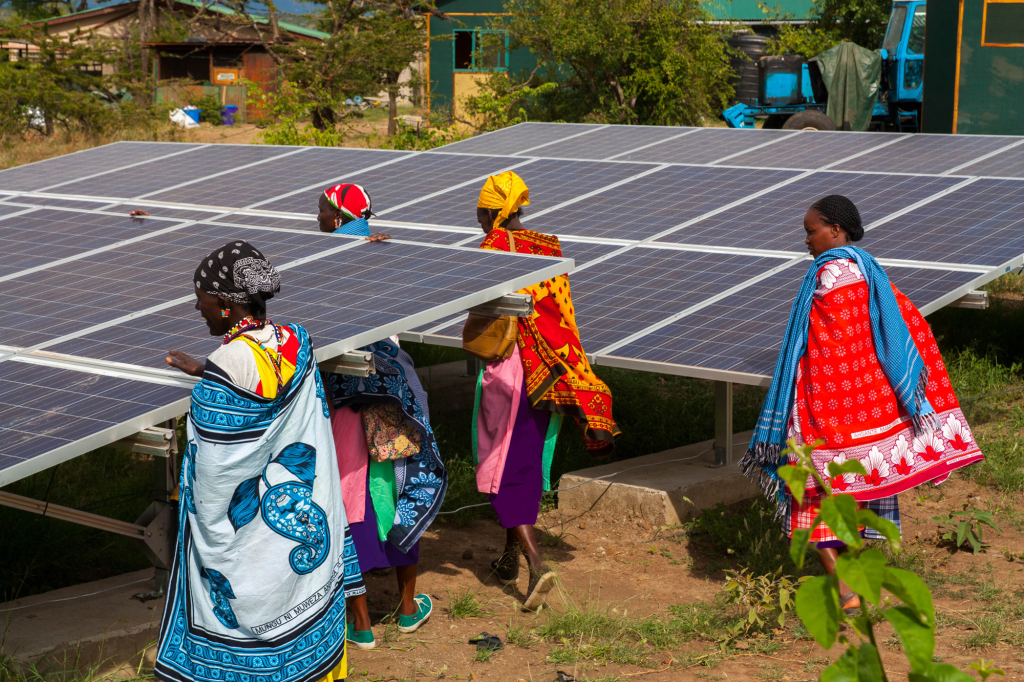
Solar mini-grid installation in rural Kenya. Photo: ImpactAlpha.
For pastoralist communities such as the Maasai, these dynamics are especially visible. Mobility has long been part of livelihood strategies tied to seasonal grazing and water access. What has changed is predictability. Repeated drought, land fragmentation, and competing land uses have narrowed adaptive options. Movement increasingly reflects constraint rather than choice, carrying cultural and economic costs that are often overlooked in policy debates.
Kenya’s experience is also shaped by decisions made beyond its borders. European institutions play a significant role through climate finance and infrastructure investment. The European Commission and the European Investment Bank support electrification and clean energy projects across Kenya. These investments influence not only emissions outcomes but also resilience. Infrastructure choices determine where power flows, how systems are maintained, and who benefits.
So is the world ready for more climate migration? Not yet.
Readiness is not defined by border policy alone. It is defined by whether people can remain safely and productively where they are. From an energy and governance perspective, that depends on whether power systems are designed for reliability, whether institutions adapt as conditions change, and whether climate finance prioritizes long-term performance over speed.
In a warming world, people will move. The more important question is whether movement becomes a last resort or an expected outcome of fragile systems. Kenya’s power system shows that the answer lies not only in climate ambition, but in how sustainability, energy policy, and resilience are built into everyday infrastructure.
 Tabitha Florence Shikuku
Leave a comment